 Off The Grid Play
Rolling the Dice: The Delicate Art of Luck in Game Design
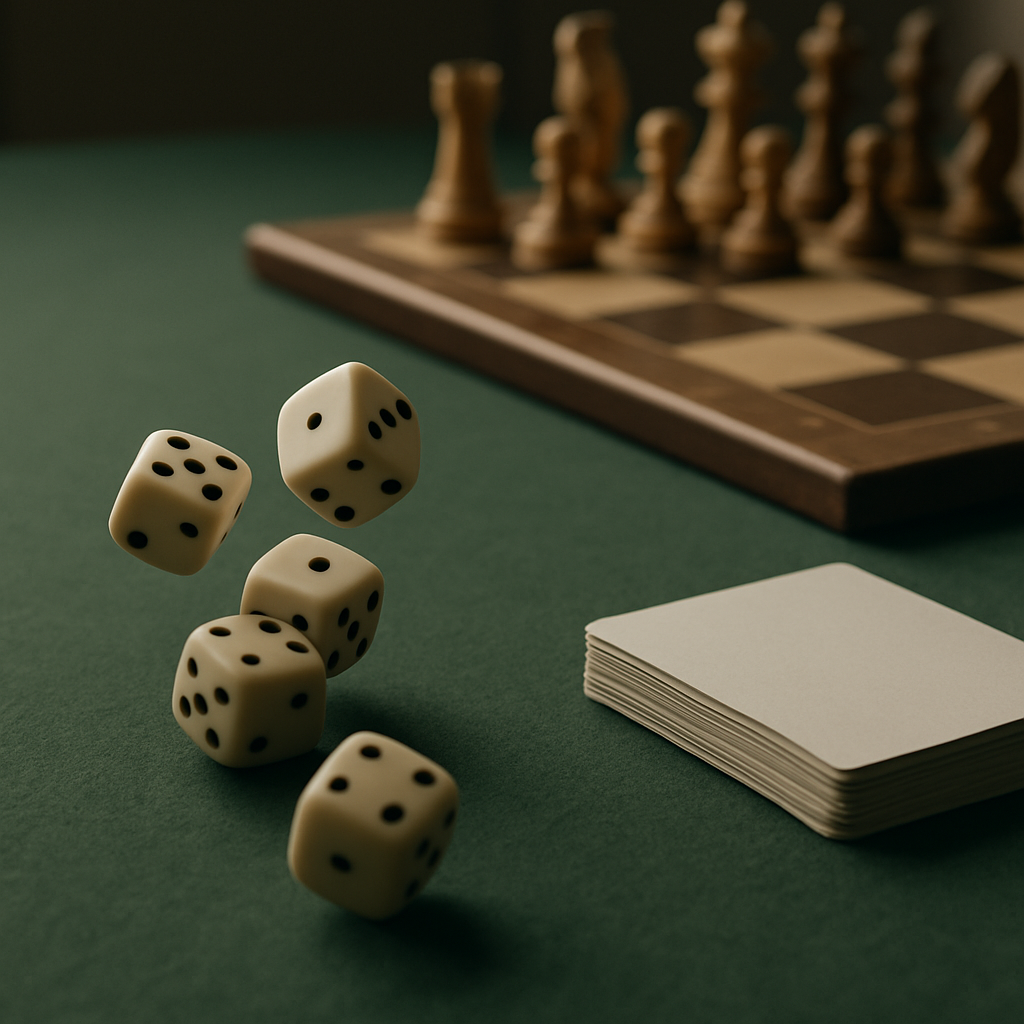
Every game sits somewhere on a spectrum between chess and a coin flip. At one end, pure skill: the better player wins, always, and the outcome is in principle knowable from the first move. At the other, pure chance: no decision matters, and a toddler beats a grandmaster half the time. Almost every beloved game in history lives somewhere in the messy, fascinating middle — and where a designer places it on that spectrum shapes everything about how the game feels. Randomness may be the most misunderstood ingredient in play, dismissed as the enemy of skill when it's often the secret to a game's soul.
What Luck Actually Does for a Game
Ask casual players why dice and shuffled decks exist and you'll hear "variety." True, but incomplete. Randomness performs several distinct jobs.
It creates hope. In a pure skill game, the weaker player knows the outcome early, and knowing kills fun. A dash of luck keeps everyone believing until the end — which is why family classics from backgammon to Uno lean heavily on chance. Luck is a handicapping system that nobody has to negotiate.
It generates stories. Nobody retells a game that went exactly as expected. The miracle draw, the catastrophic roll at the worst moment, the one-in-a-hundred comeback — chance manufactures the narrative spikes that make sessions memorable.
It forces adaptation. With randomness in the system, you can't memorize your way to victory. Poker players must play the hand they're dealt; strategy gamers must improvise when the card river betrays them. Chance converts games from puzzles to be solved into situations to be navigated — a much deeper and more replayable kind of challenge.
It provides cover. Psychologically, luck is a shock absorber. Losing a pure skill game says something uncomfortable about you; losing a luck-tinged game lets everyone save face. "The dice hated me tonight" is one of play's great social lubricants.
Input Luck vs. Output Luck
Designers make a crucial distinction that every player intuitively feels. Input randomness happens before your decision: the tiles you draw in Scrabble, the terrain generated in a roguelike, the cards in your opening hand. You then make choices with full knowledge of the random result. Output randomness happens after your decision: you choose to attack, then roll to see if it worked.
Input randomness tends to feel fair and interesting — the game deals you a situation, and your skill lies in responding. Output randomness is spicier and riskier: it adds drama but can make players feel robbed when a good decision is punished by a bad roll. The infamous rage moments in gaming — the 90% shot that misses in XCOM — are almost always output luck. Neither type is wrong, but great designers deploy output randomness carefully, usually softening it with ways to hedge, reroll, or mitigate.
The Mathematics of Feeling Cheated
Human intuition about probability is famously terrible, and games live inside that gap. Players experience a 75% chance as a promise; when it fails twice running — which happens more than one time in sixteen — they suspect the game is broken. Designers respond with a fascinating trick: lying kindly. Many video games quietly inflate displayed odds or use "pseudo-random" systems that prevent long unlucky streaks, because honest dice feel dishonest.
Tabletop design has its own smoothing tools. Rolling two dice instead of one creates a bell curve, making middle results common and extremes rare — the reason Catan's resource engine feels dependable rather than chaotic. Card decks are "randomness with memory": once the ace is played, it's gone, so probabilities shift in trackable ways, rewarding attentive players. Bags of tokens, drafted hands, and rotating markets all offer different textures of chance, each with its own emotional flavor.
Finding Your Group's Luck Tolerance
There's no correct amount of randomness — only the right amount for a purpose and a player. A few practical observations for anyone curating a game shelf:
- High-luck games shine with mixed company. When skill levels vary wildly (family holidays, casual parties), luck is kindness.
- Low-luck games suit rivals. Evenly matched players who want the win to mean something should reach for chess-like designs.
- The sweet spot for most groups is luck you can manage. Games where chance sets the stage but decisions decide the play — poker, backgammon, most modern board games — deliver both drama and agency.
- Watch reactions to bad beats. Some players relish variance; others are quietly miserable. The best game night matches the dice to the temperament.
In Praise of the Unknowable
There's a philosophical kernel here worth keeping. Games are rehearsals for life, and life is neither chess nor a coin flip — it's the middle of the spectrum, skill exercised under uncertainty. Randomness in games isn't a corruption of fair competition; it's the most honest thing about them. The dice teach what every adult eventually learns: you don't control outcomes, only decisions. Play the odds, hold your plans loosely, and when the roll goes against you — shuffle up and deal again.